
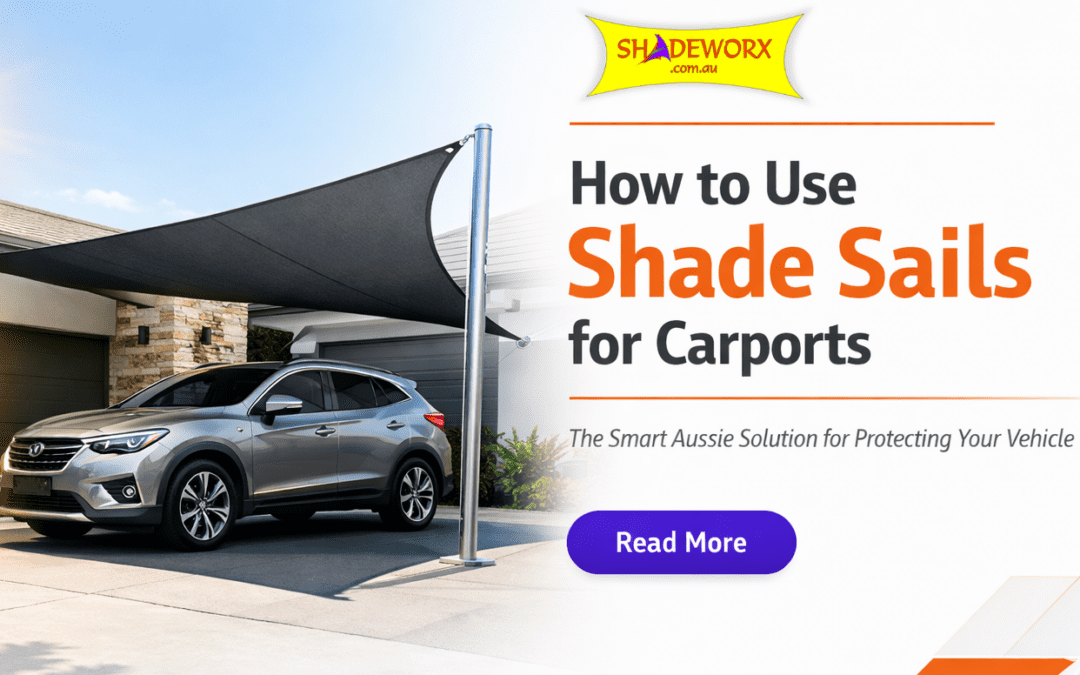
At Shadeworx, we’ve spent 30+ years manufacturing Australian-made shade solutions for homes, businesses, and everything in between. Here’s everything you need to know about using shade sails as carports — done right.
⚡ Quick Summary
- Blocks up to 95% of harmful UV rays
- Costs significantly less than a traditional carport
- Suits DIY installation or professional fitting
- Lasts 8–12 years with proper care and maintenance
- Available in standard sizes or fully custom shapes
What Is a Shade Sail Carport?
A shade sail carport is a tensioned fabric canopy installed above a parking area to protect vehicles from UV rays, heat, and weather. It is a cost-effective, flexible alternative to traditional carports and can block up to 95% of harmful UV radiation. Mounted between fixed anchor points — posts, walls, or existing structures — it creates a purpose-built shaded canopy directly over your vehicle.
Unlike a full roofed structure, a DIY shade sail carport can be installed without council approval in most cases, repositioned if your needs change, and tailored to virtually any parking layout. It’s the kind of carport shade solution that just makes sense for the Australian lifestyle.
Benefits of Using a Shade Sail Carport in Australia
There are some seriously good reasons Australians are switching to shade sails over traditional structures. Here’s what you actually get:
UV and heat protection — A quality car shade sail blocks up to 95% of UV rays, dramatically reducing interior temperatures and protecting your paintwork, dashboard, and upholstery from long-term sun damage.
Lower cost — You’re looking at a significantly smaller outlay compared to a fully constructed carport — without compromising on protection or durability.
Excellent airflow — Unlike a sealed solid roof, shade sails allow natural air circulation, which actively helps reduce heat build-up beneath the canopy. Less heat trapped means a cooler car.
Built for Australian conditions — At Shadeworx, our sails are manufactured from commercial-grade HDPE fabric, engineered specifically for harsh UV exposure, coastal salt air, and strong winds. This isn’t off-the-shelf imported stock — it’s Australian-made for Australian conditions.
Modern aesthetics — A well-installed shade sail looks far more contemporary than a corrugated iron roof bolted to the side of the house.
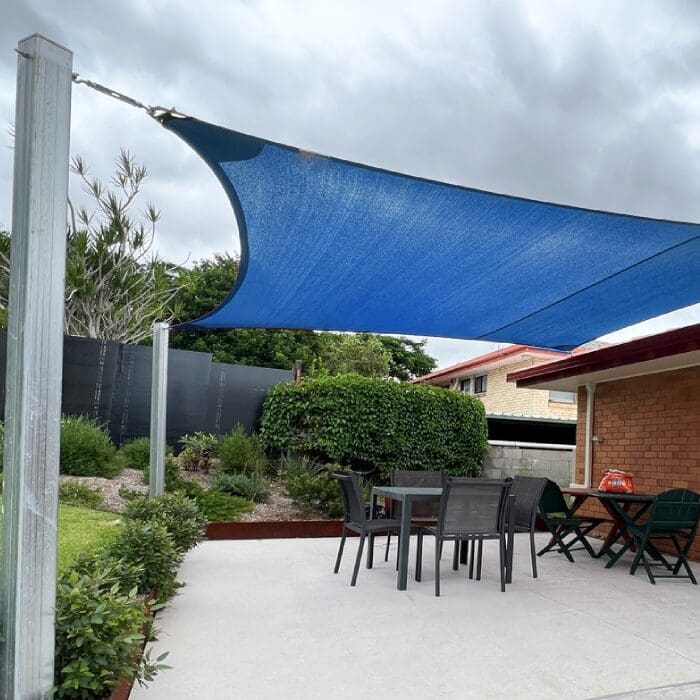
Most Popular
Shadeworx Recommended
4-Point Shade Sail — 3m Wide x Variable Lengths
$325.00 – $450.00 GST exclusive
Australia’s most popular carport sail — rectangular, DIY-friendly, and engineered with UV-stabilised fabric and steel cable edges to outlast the harshest Aussie summers.
← Scroll to see full table →
| Feature | Shade Sail Carport | Metal Carport | Timber Pergola |
|---|---|---|---|
| Upfront Cost | Low–Medium | Medium–High | High |
| Installation Time | 1–2 days | 1–3 days | 3–7+ days |
| Council Approval | Often not required | Usually required | Usually required |
| UV Protection | Up to 95% | Full (solid roof) | Moderate |
| Ventilation | Excellent | Limited | Good |
| Flexibility | Relocatable | Permanent | Permanent |
| Lifespan (quality) | 8–12 years | 20+ years | 15–25 years |
| Maintenance | Low | Low–Medium | Medium–High |
Bottom line: If you want cost-effective, fast, flexible vehicle protection that doesn’t require a building permit or a tradie army — a shade sail carport is your best bet. If you’re building a permanent family entertaining area and want full waterproofing, a pergola or metal carport might suit better long-term.
Choosing the Right Car Shade Sail in Australia
This is where a lot of people go wrong. They grab the cheapest option off the shelf and wonder why it’s flapping in the breeze six months later. Here’s what to look for when choosing a carport shade solution that actually lasts.
Material: The Most Important Factor
Go for commercial-grade HDPE (High-Density Polyethylene) fabric. It should be:
- Knitted for breathability and flexibility under wind load
- UV-stabilised throughout the entire weave — not just coated on the surface
- Rated at 90–95%+ UV block
- Reinforced at all edges and corner ring points
Avoid cheap, webbing-edged sails. They deteriorate fast — edges fray, tension is lost, and you’re replacing the whole thing within a couple of years. Not all shade sails are equal, and the difference shows up fast under Australian conditions.
Hardware: Don’t Cut Corners Here
The fixing hardware is just as critical as the sail fabric. Shadeworx uses 316 marine-grade stainless steel hardware — the same specification used in coastal and marine environments. It resists corrosion, maintains its rated strength, and won’t let your sail down when a southerly buster rolls through.
Shape and Size for Your Carport
Shade sails are available in triangles and quadrilaterals (squares and rectangles):
- Single car: Typically 5m x 5m square or a large triangle
- Double car: Typically 5m x 8m or a custom quadrilateral
- Unusual spaces: A custom-manufactured sail can be built to your exact footprint and attachment points
Pro Tip: Measure your parking area, add roughly 600mm overhang on all sides, and factor in the angles of your anchor points before ordering. When in doubt, go slightly larger — you can always increase tension, but you can’t stretch a sail that’s too small.
How to Install a DIY Shade Sail Carport in Australia: Step-by-Step
Installing a waterproof shade sail carport or standard UV-protection sail is a manageable DIY project for most homeowners — provided you plan carefully and use the right hardware. Here’s how to do it properly:
- Plan your anchor points
Identify where each fixing point will go. Anchor points can be existing walls, fences, or purpose-built steel posts. These points must be structurally sound — shade sails under wind load generate considerable tension force. - Install posts if needed
If you don’t have suitable existing structures, install 65–75mm steel posts set in concrete footings at least 600mm deep. Angle posts slightly outward (away from the centre of the sail) so that tension from the sail pulls them upright under load. - Attach the hardware
Fix pad eyes, D-shackles, and turnbuckles to each anchor point using 316 stainless steel hardware throughout. In coastal or high-humidity environments, this step is non-negotiable. - Attach the sail
Connect each corner ring of the sail to the corresponding hardware attachment point. Keep everything loose at this stage — tensioning comes next. - Tension the sail evenly
Tighten the turnbuckles gradually and evenly across all attachment points. A correctly tensioned sail is taut but not rigid — no sagging, no pooling, and minimal flutter in light wind. - Check the pitch
Make sure your sail has enough pitch (angle) to allow rainwater to run off rather than pool. Aim for at least 20–30 degrees on your lowest corner. A flat sail is a bathtub waiting to happen.
Want more detail? Download our DIY shade sail installation guide for Australian homes for step-by-step photos, post sizing, and footing specs.
Are Shade Sail Carports Waterproof?
This is one of the most common questions we get — and the honest answer is: it depends on the fabric you choose.
Standard knitted HDPE shade cloth is water-resistant, not fully waterproof. It handles light drizzle and dramatically reduces direct rainfall, but heavy rain will penetrate the weave to some degree.
If full waterproofing is a priority — especially in Queensland or coastal areas with heavy summer storms — a waterproof shade sail carport using PVC-coated or woven waterproof fabric is the answer. Shadeworx offers this as a custom option, giving you year-round protection without sacrificing the flexibility of a shade sail system.
How Long Does a Shade Sail Carport Last in Australia?
Based on industry best practices and 30+ years of manufacturing experience in Australian conditions, a quality commercial-grade shade sail — correctly installed and maintained — should last 8–12 years.
Budget sails with poor UV stabilisation or inferior stitching might hold up for a year or two, then deteriorate rapidly. Fading colour, fraying edges, and lost tension are the telltale signs.
To get the most out of your shade sail:
- Remove and store during major storm events where possible
- Clean periodically with mild soapy water — no bleach, no harsh chemicals
- Inspect hardware annually and lubricate turnbuckles
- Re-tension after the first summer, as fabric can stretch slightly under initial UV exposure
Common Mistakes to Avoid With a Shade Sail Carport
Even the best sail won’t perform well if the installation is off. Here’s what we see go wrong most often:
Installing it flat — A flat sail holds water like a bucket. Always ensure adequate pitch for drainage.
Undersizing the anchor points — The tension forces on a shade sail in wind are significant. A bolt through a timber paling fence won’t hold. Use structural anchors.
Buying the wrong size — Too small leaves your vehicle exposed. Too large and you can’t achieve proper tension. Measure carefully before ordering.
Using the wrong hardware — Zinc-plated or standard galvanised hardware rusts within a year or two in coastal or humid conditions. Always use 316 stainless steel.
Ignoring wind events — No shade sail is designed to withstand cyclonic conditions while fully tensioned. In high-wind or cyclone-prone areas, de-rig your sail before major storms.
Frequently Asked Questions About Shade Sail Carports
Can a shade sail protect my car from UV damage?
Absolutely. A quality commercial-grade shade sail blocks up to 95% of UV rays, significantly reducing heat build-up and protecting your vehicle’s paintwork, interior plastics, and dashboard from long-term UV degradation.
Are shade sail carports waterproof?
Standard knitted HDPE shade cloth is water-resistant but not fully waterproof. For complete waterproof coverage, opt for a PVC-coated or woven waterproof fabric. Shadeworx offers this as a custom solution for clients in wetter or coastal climates.
Do I need council approval for a shade sail carport in Australia?
In most Australian states, shade sails under certain height and area thresholds don’t require a building permit — but it varies by council and state. Always check with your local authority before installation to confirm your specific requirements.
What size shade sail do I need for a carport?
For a single car, allow approximately 5m x 5m. For a double car space, around 5m x 8m. Add 600mm overhang on all sides and account for the angle of your anchor points. When in doubt, go slightly larger.
What’s the difference between a cheap shade sail and a commercial-grade one?
The key differences are fabric UV stabilisation depth, stitching quality, edge reinforcement, and hardware grade. Commercial-grade sails — like those manufactured by Shadeworx — use superior materials throughout, holding their tension, colour, and structural integrity far longer than budget alternatives.
Is a shade sail good for a carport long-term?
Yes — when made from quality materials and correctly installed, a shade sail carport is an excellent long-term solution for vehicle protection. With proper maintenance, you can expect 8–12 years of reliable performance.
Real-World Applications: Where a Car Shade Sail Works Best
Shade sails for car protection work brilliantly across a wide range of residential and commercial settings:
- Suburban driveways where a full carport structure isn’t practical or permitted
- Rental properties where a removable, non-permanent solution is needed
- Rural properties where multiple vehicles need economical shading across large areas
- Caravan and boat storage where tall clearance is essential
- Commercial yards and fleet parking where multiple vehicles need fast, cost-effective shade coverage
Why Shadeworx Is Australia’s Trusted Shade Sail Manufacturer
Shadeworx isn’t just another shade sail reseller. We design and manufacture our own products right here in Australia — which means every sail is built with a deep understanding of what Australian conditions actually demand.
✔ 30+ years of Australian manufacturing experience
✔ Commercial-grade HDPE fabric with superior UV stabilization
✔ 316 marine-grade stainless steel hardware on every product
✔ Custom shade sail solutions designed to your exact specifications
✔ Engineered for Australian conditions — from coastal salt air to outback UV
Not all shade sails are equal. And when your vehicle is sitting under the Australian sun day after day, that difference really matters.
Get the Right Shade Sail Carport for Your Space
Whether you need a standard size to suit a single driveway or a fully custom shade sail carport built to your exact dimensions, our team can help you design the right solution.
✔ Australian-made for harsh conditions
✔ 30+ years of expertise behind every product
✔ Custom quotes with no obligation
Updated March 2026 | Written by the Shadeworx team — Australia’s shade sail specialists since 1994
