
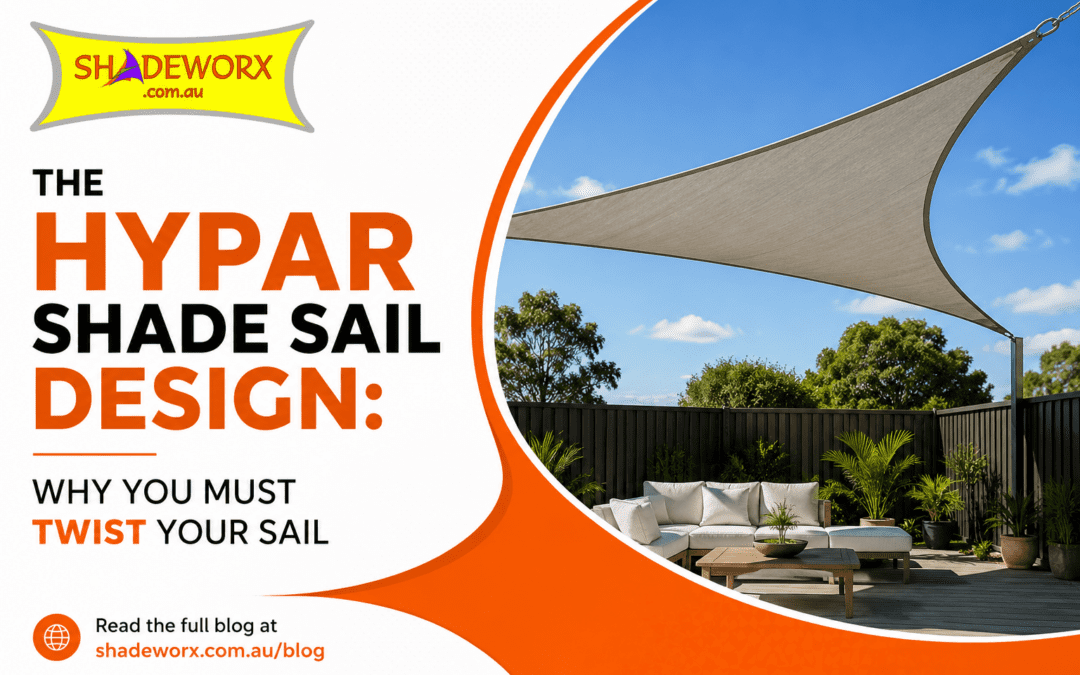
Most people assume the twist in a shade sail is there to make it look good. It’s a reasonable assumption — the shape is striking, it looks modern, and it photographs beautifully above a pool or patio. But the twist is not a design choice. It’s a structural requirement.
If you install a shade sail without the correct twist, you are not installing a shade structure. You are installing a parachute. And Brisbane’s summer storms will treat it exactly like one.
This article explains what a hypar shade sail design actually is, why the geometry matters, and how getting it right — or wrong — determines whether your sail lasts years or fails within a single wet season.
What Is a Hypar Shade Sail?
A Hypar shade sail is a four-corner shade structure with two high corners and two low corners positioned diagonally opposite each other. The resulting twist creates a hyperbolic paraboloid shape that improves tension, drainage and wind resistance — and makes the sail far more durable than a flat installation.
What Is a Hypar Shade Sail Design?
A Hypar shade sail is a four-corner shade structure that uses two high corners and two low corners — positioned diagonally opposite each other — to create a twisted three-dimensional shape. This twist increases fabric tension, improves wind resistance, encourages rain runoff and helps the sail maintain its shape over time.
The word “hypar” is shorthand for hyperbolic paraboloid — a geometric surface that curves in two directions at once. Picture a saddle shape, or the curved roof of a modern sports stadium. That’s the form a correctly installed four-corner shade sail creates when the fixing points are staggered in height.
Two corners go high. Two corners go low. The diagonal opposite corners share the same level. This creates a sail that twists through three dimensions rather than sitting as a flat plane.
That twist is everything.
Hypar Shade Sail vs Flat Shade Sail: What’s the Difference?
If you’re weighing up whether the twist actually matters, this comparison makes it clear.
| Factor | Hypar Shade Sail | Flat Shade Sail |
|---|---|---|
| Wind Resistance | Excellent — membrane tension distributes load across the full sail | Poor — flat fabric generates uplift and acts like a sail in strong wind |
| Water Runoff | Excellent — natural drainage toward low corners | Poor — water pools in the centre, adding weight and stretching the fabric |
| Fabric Lifespan | Longer — reduced flapping means less fibre fatigue | Shorter — constant movement degrades fibres and stitching faster |
| Maintenance Required | Lower — correct tension holds shape with minimal adjustment | Higher — regular re-tensioning needed as fabric stretches and sags |
| Storm Performance | Well suited to SEQ storm conditions | High failure risk in strong gusts or heavy downpours |
| Shade Effectiveness | Better — corner height variation gives you control over sun angles | Less control — shade falls where it falls regardless of sun direction |
| Suitable for Brisbane | Yes | No — not recommended for Queensland’s UV, wind and rainfall |
The flat sail is not simply a less attractive option. It is a structurally inferior one.
Why Twisting a Shade Sail Is a Structural Requirement, Not a Style Choice
Think about the difference between a flat bedsheet held up by four posts at equal heights, and a piece of fabric pulled tight in opposite directions. The flat sheet flaps, sags and billows. The tensioned fabric holds its shape.
A flat shade sail behaves like that bedsheet — and like a parachute. Wind gets underneath it, creates uplift and puts enormous strain on every fixing point and post footing. In a Brisbane storm, that’s a recipe for a torn sail, a snapped post, or a sail that takes flight entirely.
A hypar shade sail behaves like a tensioned membrane. By creating two opposing curves — one curving upward on one diagonal, one curving downward on the other — the hyperbolic paraboloid shape distributes structural loading in multiple directions at once. The fabric is held under three-dimensional tension across its entire surface, not just pulled from the corners.
This is the same engineering principle used in tensile membrane structures — the large fabric roofs you see over stadiums, bus terminals and public squares. The curve creates the strength.
Without the twist, you have a sail. With the twist, you have a structure.
At Shadeworx, we’ve seen many failed shade sail installations caused by insufficient height variation between fixing points. The sails aren’t defective — the geometry is wrong. A correctly manufactured sail installed without enough twist simply cannot perform the way it was designed to.
Why Do Shade Sails Sag? (And Why Twist Fixes It)
A sagging shade sail is almost always the result of one of three things: insufficient height variation between fixing points, a sail that’s been sized incorrectly for the span, or a webbing-edged sail that has stretched under load over time.
When a sail sags, the centre drops lower than the corners. This creates a low point where water collects, which adds weight, which pulls the centre down further. The posts start to lean inward from the cable tension. The footing footprints widen. The whole system progressively loses geometry.
The hypar shape directly prevents this. Because two corners are high and two are low, there is no centre sag point — the fabric is curved, not flat, and the tension runs diagonally across the membrane rather than pulling everything toward the middle.
Research into tensile membrane structures consistently shows that pre-tensioned curved membranes maintain their geometry far better over time than flat fabric installations under the same load conditions. The curve does the structural work.
If your existing sail is sagging, the fix is rarely a new sail — it’s a redesign of the fixing point heights.
Why Is My Shade Sail Collecting Water?
Water pooling on a shade sail is a sign the sail is either too flat, or the height variation between your high and low corners isn’t enough to create a useful drainage gradient.
A single summer storm in Brisbane can drop 50mm of rain in under an hour. At that rate, even a modest-sized shade sail can collect hundreds of kilograms of water if it has nowhere to drain. Ten litres of water weighs ten kilograms. A 4m x 4m sail sitting in a 50mm downpour can accumulate over 800 kilograms of load before the water reaches the edge.
That weight stretches the fabric. It pulls the seams. It leans the posts. And if the sail fabric is non-waterproof shade cloth, water will be dripping through — but the weight still accumulates before it does.
High and low fixing points solve this by creating a permanent slope across the sail surface. Rainwater follows the geometry toward the two low corners and runs off the edge rather than sitting in the middle. With the right height variation, pooling simply doesn’t happen.
Can a waterproof shade sail be flat? Technically it can be manufactured flat, but it absolutely should not be installed flat. A waterproof sail with no drainage gradient will pool faster and with greater load than a standard shade cloth sail, because the water has nowhere to go until the sail physically can’t hold any more weight.
How Twisting a Shade Sail Improves Wind Performance
Wind is the primary enemy of a poorly designed shade sail, and this is especially true in South East Queensland where sudden afternoon storms can bring strong gusts with very little warning.
When a flat sail catches wind, it does two things. First, it acts like a sail on a boat — generating lift and lateral pull that loads up your posts and anchor points. Second, it flaps. And flapping is what destroys shade cloth over time.
Every time a sail flap occurs, the fabric fibres flex. Thousands of flexes per storm. Tens of thousands per season. Research into flexible membrane materials shows that repeated cyclic flexing — the kind caused by wind-induced flapping — significantly accelerates fibre fatigue compared to membranes held under constant tension. The fibres weaken, the stitching fatigues, the perimeter edge stretches. You end up with a sail that looks worn within a few years rather than lasting the decade or more a quality shade sail should deliver.
A correctly twisted hypar shade sail dramatically reduces flapping. The three-dimensional tension across the membrane means there is no loose fabric to catch the wind and snap. Wind passes over and around the curved surface rather than pooling beneath it. The structural loading is distributed across the fabric evenly rather than hammering the centre and corners.
This is not a marginal improvement. It is the difference between a sail that survives storms and one that doesn’t.
How Tight Should a Shade Sail Be?
This is one of the most common questions we hear, and the honest answer is: tighter than most people think, but not so tight you’re damaging the fabric or the fixings.
A properly tensioned shade sail should feel firm to the touch across the full surface. If you press down in the centre, there should be resistance — not a hammock-like give. The edges should be taut, not drooping between attachment points.
The technical target for a tensioned shade sail is around 1-2kN of cable tension on each edge, though this varies with sail size and configuration. For most DIY installers, the practical guide is simpler: the sail should be drum-tight. If you can see the fabric moving in a light breeze, it needs more tension.
Getting to this tension level is only possible with a sail that has the correct hypar geometry. A flat sail or one with insufficient height variation cannot be tensioned properly — there’s no opposing geometry to pull against. You can tighten the turnbuckles all you like, but without the three-dimensional form, the fabric will never reach the tension it needs.
Cable-edged sails are also far easier to tension correctly. The 316 stainless steel cable holds the edge geometry firm as you wind up the turnbuckles. Webbing-edged sails often reach a point where the webbing itself starts to give under load, meaning the sail never achieves full tension regardless of how hard you try.
Why High and Low Fixing Points Prevent Water Pooling
Brisbane summers bring heavy rainfall. A single thunderstorm can dump 50mm or more in under an hour. If your shade sail has any flat sections or insufficient pitch, that water has nowhere to go.
Water pooling is one of the most common causes of shade sail failure. A pooled load of water is surprisingly heavy — 10 litres weighs 10 kilograms — and the weight pulls the centre of the sail downward, stretching the fabric beyond its designed tension. Seams stress. Corners pull. Posts lean. In severe cases, the whole structure fails.
High and low fixing points solve this by creating natural drainage paths. When two opposite corners are high and two are low, rainwater naturally flows toward the low points and runs off the edge of the sail. There is no flat section for it to accumulate.
The hypar geometry also means the sail surface is never truly horizontal anywhere — it is always sloping toward one of the low corners. This makes proper drainage almost automatic, provided the height difference between your high and low points is sufficient.
The Simple 15% Rule for Creating a Hypar Twist
So how much height difference do you actually need between your high and low fixing points?
A reliable industry rule of thumb is 15% of your longest span.
Here’s how to work it out:
- Measure the longest diagonal span of your intended shade sail in millimetres
- Multiply that number by 0.15
- The result is the minimum height variation you should aim for between your low and high fixing points
Worked example:
- Longest span: 7,000mm
- 7,000 × 0.15 = 1,050mm height variation
- If your low fixing point sits at 2,200mm above ground level, your high fixing point should be around 3,250mm
This is a guide, not a fixed rule. Larger sails, exposed coastal locations and waterproof shade sails often benefit from more variation. Always factor in your specific site conditions and the sun angles you’re designing for.
Hypar Shade Sail Design Checklist
Before you commit to post positions or order a sail, run through this checklist. It covers the fundamentals that separate a sail that performs well from one that causes headaches.
- Four fixing points (not three — triangle sails cannot create a hypar shape)
- Two high corners positioned diagonally opposite each other
- Two low corners positioned diagonally opposite each other
- Minimum 15% height variation across the longest span
- Low corners positioned where afternoon sun cuts under the sail
- Clear drainage path from low corners (not above a deck or doorway)
- Posts sized for the wind loading in your area
- Footings deep enough for your soil type
- Cable-edged sail for drum-tight tensioning
- Sail manufactured to your actual fixing point measurements, not bought off the shelf first
If any of these boxes can’t be ticked, the design needs to change before installation starts.
How to Position High and Low Corners for Brisbane Sun Protection
The orientation of your high and low corners affects not just drainage and wind performance, but also how well your sail actually shades the space below it.
In Brisbane, the sun tracks from the north-east in the morning to the north-west in the afternoon, sitting higher in summer and lower in winter. The strongest UV exposure for most residential properties comes from the north and west, with afternoon sun from the west being the most intense and the hardest to block with a poorly positioned sail.
Lower corners are generally most effective where the sun tends to cut under the sail. If afternoon western sun is your primary concern, positioning a lower corner on the western edge allows the sail to drop lower on that side and block the lower sun angles of late afternoon.
Higher corners work well where you need clearance — above a walkway, a gate, or where you want to maintain sightlines. Think about how people move through and use the space beneath the sail when deciding which corners go high and which go low.
For pools in particular, the sun’s movement means you often want shade over a changing footprint throughout the day. A hypar configuration lets you fine-tune that coverage far more precisely than a flat installation ever could.
Why Cable-Edged Shade Sails Perform Better in a Hypar Configuration
This is where sail construction becomes critical.
Most shade sails on the market use webbing edges — a flat strap sewn around the perimeter of the fabric. Webbing can stretch. It can distort. And when you are trying to tension a hypar sail drum-tight, a webbing edge that gives under load will stop you from achieving the tension the geometry requires.
Shadeworx manufactures all of its shade sails with 316 stainless steel cable edges sewn into the perimeter. The cable doesn’t stretch. As you tighten your turnbuckles, the cable holds the edge geometry precisely while the fabric is pulled into the correct hyperbolic paraboloid shape.
This makes a real practical difference. A cable-edged sail can be tensioned properly. A webbing-edged sail reaches a point where the webbing itself starts to give, and the sail can never achieve the tension the hypar design demands.
The result is a sail that holds its shape better, distributes load more evenly, resists wind uplift more effectively and lasts longer. The 316 grade stainless steel is also highly resistant to corrosion — important in Brisbane’s humid, salt-affected coastal suburbs where inferior hardware will start to rust within a season or two.
When a Shadeworx cable-edged sail is correctly installed in a hypar configuration, the tension across the membrane can be made genuinely drum-tight. That’s the standard the structure needs to perform in South East Queensland conditions.
Common Shade Sail Design Mistakes to Avoid
Installing a Sail Flat
The single most damaging thing you can do with a four-corner shade sail is install it flat. Equal-height fixing points mean no hypar geometry, no three-dimensional tension, and a sail that will flap, pool water and fail prematurely. If your four corners are all at the same height, the design needs to change before you dig a single post hole.
Using Insufficient Height Variation
Even if you stagger your heights, too little difference defeats the purpose. A 100mm variation across a 6-metre sail creates almost no meaningful curvature. Use the 15% rule as your minimum and err toward more variation rather than less.
Undersized Posts and Footings
The forces on shade sail posts are substantial, especially in wind. Undersized steel posts will flex. Shallow footings allow posts to lean. Both problems progressively worsen the geometry of the hypar and reduce tension over time. Concrete footings should be sized appropriately for your soil type and the expected wind loading in your area.
Choosing an Off-the-Shelf Sail Before Measuring Fixing Points
Many DIY installers buy a standard-size sail and then try to make their posts fit. This rarely works well. The correct approach is to establish your fixing point locations first — based on the space, the sun angles and the required clearances — and then have your sail manufactured to those measurements. Shadeworx produces custom shade sails using CAD software designed specifically for tension membrane structures, so the fabric is cut to account for stretch and curved edge geometry.
Ignoring Drainage Paths
Even with a correct hypar geometry, water runs toward the low corners. If those low corners sit above garden beds, timber decking or areas where dripping water causes problems, you’ll create ongoing maintenance headaches. Plan where the water goes before you finalise your corner positions.
DIY vs Professional Shade Sail Design: Getting the Twist Right
A well-designed hypar shade sail is achievable as a DIY project, but it requires more planning than most people expect.
The geometry needs to be calculated correctly. The posts need to be sized for the loads. The footings need to suit the soil. And the sail itself needs to be manufactured to the actual distances between your fixing points — not to a rough estimate made after the posts go in.
Professional shade sail manufacturers use CAD software that accounts for fabric stretch, the curved edges of a tensioned membrane and the precise geometry of a hypar shape. When you order a custom sail from Shadeworx, those variables are built into the cut of the fabric from the start. The result is a sail that, when tensioned properly, sits in exactly the right three-dimensional shape.
If you’re confident in your measurements and comfortable with the installation process, Shadeworx’s custom DIY shade sails — available through diyshadesails.net.au — give you a professionally manufactured sail at a DIY price point. If the geometry or structural side feels beyond your comfort zone, a professional installer is the smarter option.
Final Thoughts: The Twist Is What Makes a Shade Sail Work
A hypar shade sail design is not optional for a four-corner sail. It is not a styling preference. It is the mechanism by which the sail achieves its structural integrity.
The twist creates three-dimensional tension across the membrane. That tension is what stops the sail flapping in Brisbane storms. It is what sheds water instead of pooling it. It is what allows the fabric to last years rather than failing within a season.
If you are planning a shade sail installation — for a residential pool, a family patio, a commercial outdoor area or a school playground — start with the geometry. Get your high and low fixing points right. Make sure the height variation is sufficient. And choose a cable-edged sail if you want one that can actually be tensioned to the standard the hypar design demands.
The performance difference is not subtle. It is structural.
Frequently Asked Questions
Looking for a custom shade sail built for Brisbane conditions? Explore Shadeworx’s waterproof shade sails, pool shade sails, commercial shade sails — all manufactured with 316 stainless steel cable edges and designed for drum-tight hypar tensioning.
