
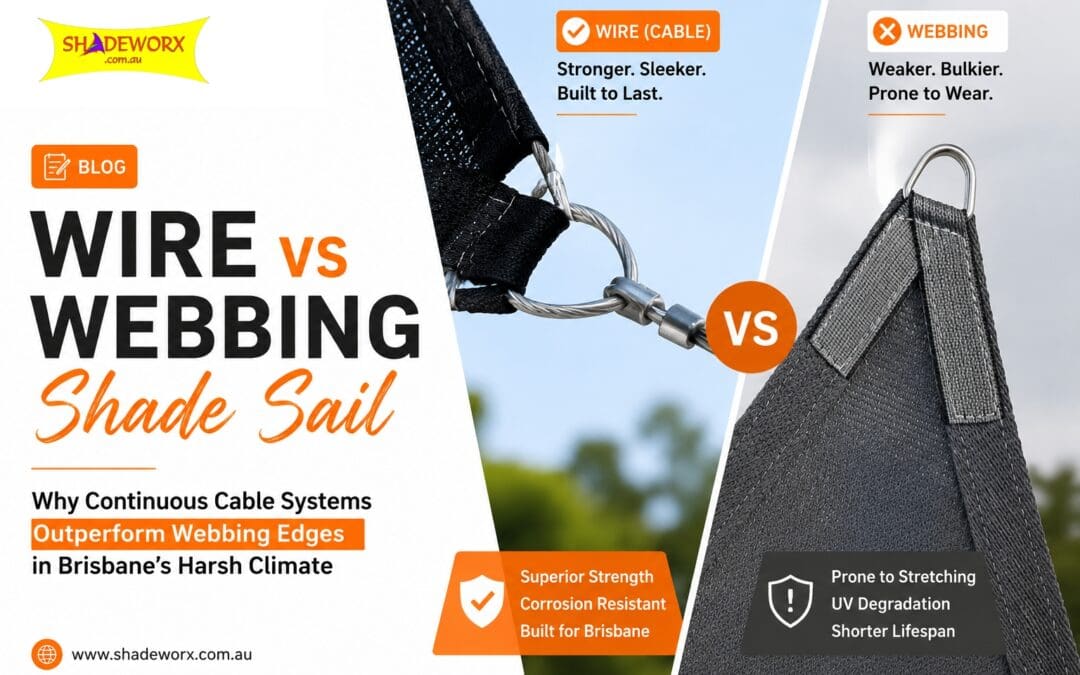
Brisbane is not a forgiving environment for outdoor structures. The UV Index regularly exceeds 10 during summer, according to the Australian Radiation Protection and Nuclear Safety Agency. Storm season brings wind gusts above 80 km/h. Summer temperatures push past 35 degrees for weeks at a time. Any product you put outside needs to be built for these conditions, not just rated for them on a label.
If you have walked past a neighbour’s sagging, flapping shade sail and wondered why yours looks the same way after just a couple of seasons, the answer almost always comes down to one critical engineering decision: wire edge vs webbing edge construction.
In Short
Wire edge shade sails outperform webbing edge sails because the continuous stainless steel cable maintains tension, resists UV degradation and distributes load more effectively. Webbing is a fabric product. It stretches under heat and load. Once it stretches, the sail sags and the problems compound from there.
Not all shade sails are built to the same standard. The difference between a sail that stays tight through a Brisbane storm and one that fails within a few seasons is not the fabric. It is the perimeter system holding everything together.
Wire vs Webbing Shade Sail: Key Takeaways
- Wire edge shade sails use a continuous 316 stainless steel cable around the perimeter.
- Webbing edge shade sails use a fabric strap sewn around the edge.
- Steel does not stretch. Webbing does, especially under Queensland heat and sustained load.
- A sagging sail flaps in wind, pools water and places extreme stress on anchor hardware.
- Wire edge sails typically last 10 or more years. Webbing sails often require replacement within 3 to 5 years.
- Commercial projects at schools, childcare centres and public venues almost always specify wire edge systems.
- Shadeworx does not manufacture webbing-edge sails for any application.
Understanding the Difference Between Wire Edge and Webbing Edge Shade Sails
What Is a Webbing Edge Shade Sail?
A webbing edge shade sail uses a reinforced polyester strap sewn directly around the perimeter of the sail. This strap carries the tension and clips into the anchor hardware at each corner. The stitching between the webbing and the sail fabric is the critical connection point.
This is the construction method used in almost every shade sail sold through hardware stores and online marketplaces. It is cheap to manufacture, which is why those sails are cheap to buy. But that cost saving comes with a structural compromise that becomes obvious within a few years of installation.
What Is a Continuous Cable Shade Sail?
A continuous cable shade sail contains a single unbroken 316 stainless steel cable that runs around the entire perimeter of the sail. It enters at one anchor point, runs continuously through a fabric pocket sewn along the edge, and connects back through D-ring thimbles at each corner.
The cable is the structural skeleton of the sail. It carries the tension load. The fabric fills the space defined by the steel perimeter and does its job as a sun and weather barrier, protected from the mechanical stress that webbing systems place directly on stitching and fabric.
Quick Answer: What Is a Continuous Cable Shade Sail?
A continuous cable shade sail features a single 316 stainless steel cable running around the entire perimeter without joins or breaks. The cable carries load directly to each anchor point through D-ring thimbles, protecting the fabric from excessive tension stress. This design maintains consistent shape and tension across many years of service.
Wire vs Webbing Shade Sail — The Engineering Difference
Shade sails are tension membrane structures. They only function correctly when held under high, consistent tension. The moment tension is lost, the sail loses its engineered shape, starts moving in the wind and begins to fail.
Here is where physics matters.
Webbing is a woven fabric product. Like all woven fabrics, it stretches under sustained load. In Queensland’s summer heat, that stretch accelerates significantly. Every hour the sail sits under tension in the sun, the webbing is slowly elongating. The stitching absorbs a portion of the force with every gust of wind. Over weeks and months, the webbing stretches further. The fabric relaxes. The sail begins to sag.
A 316 stainless steel cable does not stretch. Steel under tension remains dimensionally stable across the full temperature range you experience in South East Queensland, from winter mornings through to 40-degree summer afternoons. The cable transfers load directly to the anchor points. The fabric is not being asked to carry structural load. It is simply filling the space the steel perimeter defines.
That is the fundamental engineering difference between wire vs webbing shade sail construction. One uses a structural material engineered for the job. The other uses fabric to carry a load that fabric is not designed to handle.
Why Is My Shade Sail Sagging?
Quick Answer: Why Is My Shade Sail Sagging?
Shade sail sagging is almost always caused by webbing stretch or fabric creep. As webbing elongates under heat and sustained tension, the sail loses its taut profile. Water pools in the centre, wind catches under the dip, and stress concentrates at the anchor connections. Once webbing has stretched, no amount of re-tensioning will restore the original shape.
If your shade sail is sagging, these are the most common causes:
- Webbing stretch under sustained tension and Queensland heat
- Fabric creep, where the sail body slowly elongates at stress concentration points
- Inadequate tensioning hardware that cannot hold position over time
- Anchor points that flex or move under dynamic wind load
Sagging is not just a visual problem. A sagging sail creates a chain of secondary failures:
- Water pools in the centre dip, adding weight and increasing anchor stress
- Wind builds pressure under the sagging section, dramatically increasing load
- Violent flapping cycles the sail through repeated stress events, wearing stitching and anchor connections
- Hardware is placed under uneven force it was not designed to absorb
Once a webbing-edge sail begins to sag, there is no reliable fix. Re-tensioning the corners will not shorten webbing that has already stretched. The sail will not return to its original engineered profile.
Quick Answer: Does Webbing Stretch Over Time?
Yes. Webbing is a woven fabric and all woven fabrics elongate under sustained load. Queensland heat accelerates this significantly. As the webbing around a shade sail perimeter stretches, the sail loses tension, sags in the centre, flaps in wind and deteriorates rapidly. This process cannot be reversed by re-tensioning.
Why Hardware Store Shade Sails Are So Much Cheaper
This is the question most buyers have but few articles answer directly. If a sail from a hardware store costs $200 and a professionally manufactured sail costs significantly more, what exactly are you paying for?
The price difference comes down to several manufacturing decisions made before the product ever reaches the shelf:
- Webbing instead of cable. Polyester webbing costs a fraction of marine-grade stainless steel cable. This single substitution dramatically reduces material costs.
- Lower GSM fabric. Cheaper sails use lighter weight shade cloth with lower UV block ratings. The fabric is less durable and degrades faster under Australian sun.
- Generic sizing. Hardware store sails are mass produced in standard shapes. They are not designed for specific installation environments or wind load requirements.
- Lower-grade hardware. The rings, clips and fixings included with budget sails are typically zinc-plated steel, not grade 316 stainless. In a coastal or subtropical environment like Brisbane, this hardware corrodes within a few seasons.
- No engineering oversight. A budget sail is not designed to AS/NZS 1170.2 wind action standards. It is produced to a price point, not a performance specification.
- Mass production offshore. Volume manufacturing with minimal quality control keeps unit costs low but removes accountability for performance in Australian conditions.
The real cost of a budget sail is not what you pay at the register. It is what you pay when you replace it two or three years later, cover installation labour again and deal with anchor hardware that has already corroded into the posts.
Real-World Example
A Brisbane homeowner installs a hardware-store shade sail over their patio for around $280. Two summers later, the webbing has stretched, the sail sags noticeably in the centre and pools water after every storm. By the third summer, a seam has torn at a corner and the sail needs replacement. Including two lots of installation hardware, they have spent over $700. A professionally manufactured continuous cable sail, installed once with marine-grade hardware, would still be performing.
The 5 Reasons Continuous Cable Shade Sails Outperform Webbing Edge Designs
1. Better Load Distribution
The continuous cable system works on a floating cable principle. Rather than concentrating load at fixed stitching points around the perimeter, the steel cable distributes tension dynamically across the entire sail edge. D-ring thimbles at each corner allow the cable to articulate slightly as load shifts in the wind, balancing forces across the full perimeter.
No single point on the sail absorbs a disproportionate share of load. In a webbing sail, the stitching at the highest stress points fails first. In a cable sail, those stress concentrations are managed by the steel itself.
2. Superior UV Resistance
The Bureau of Meteorology confirms that Queensland sits within one of the highest solar radiation zones in Australia. Brisbane regularly records UV Index levels above 10 during summer, with the Cancer Council Australia classifying anything above 3 as requiring sun protection. This level of UV radiation aggressively attacks synthetic materials, including the polyester webbing used in standard shade sail perimeters.
UV-exposed webbing becomes brittle and loses tensile strength. Stitching thread degrades faster than the fabric itself, meaning the connection between webbing and sail can fail before either material looks visibly worn. Grade 316 stainless steel is completely unaffected by UV radiation. The cable maintains its mechanical properties regardless of sun exposure. Paired with a UV resistant shade sail fabric, the result is a system where no component is the weak link.
3. Improved Wind Performance
A correctly tensioned continuous cable shade sail holds a precise hyperbolic shape. This anti-clastic curvature is not just aesthetic. The opposing curves in a properly tensioned sail direct wind efficiently around and off the surface, rather than allowing pressure to build underneath.
Brisbane’s storm season regularly delivers gusts above 80 km/h, and severe storms push well beyond that. Shade sails installed in Queensland should be designed for wind loads in accordance with AS/NZS 1170.2 Wind Actions, which sets the engineering benchmark for structures in Australian conditions. A sagging webbing sail does not hold a hyperbolic profile. It billows and flaps. Every gust cycles the sail through a stress event. Webbing stitching absorbs those impacts repeatedly until something gives way.
A cable sail under correct tension does not flap in normal wind conditions. The steel perimeter holds the shape and load transfers cleanly to the anchor structure.
4. Greater Waterproof Performance
Waterproof shade sails are manufactured with laminated fabric designed to shed rain rather than absorb it. But waterproofing only works when the sail holds its correct shape. A tight, properly tensioned sail directs rainfall toward the edges efficiently.
A sagging sail becomes a water collection basin. A single Brisbane storm can deposit significant weight in a pooled sail, placing extreme load on the anchor connections. In some cases, pooling water has torn anchor hardware from mounting structures entirely. Because a continuous cable system maintains consistent tension and shape, waterproof shade sails perform as designed throughout their service life.
5. Longer Lifespan and Lower Maintenance
Continuous cable shade sails are engineered for adjustment. Turnbuckles at each anchor point allow precise re-tensioning as seasonal temperature changes cause minor variation in the sail fabric. This takes a few minutes and restores the sail to optimal tension. A small amount of graphite anti-seize or grease on the turnbuckle threads keeps the hardware moving freely for years.
Webbing sails cannot be meaningfully re-tensioned because the problem is not the hardware adjustment range. The webbing itself has elongated. No turnbuckle setting shortens stretched fabric.
A well-maintained continuous cable shade sail can reliably provide ten or more years of service in Brisbane conditions. A webbing sail typically requires replacement within three to five years. Across a ten-year period, the lifecycle cost of the cable sail is substantially lower.
Wire Edge vs Webbing Edge at a Glance
| Feature | Wire Edge (Continuous Cable) | Webbing Edge |
|---|---|---|
| Tension Retention | Holds drum-tight tension long-term | Stretches and sags over time |
| UV Resistance | Steel unaffected; fabric protected | Webbing degrades in Queensland UV |
| Wind Performance | Hyperbolic shape sheds wind efficiently | Flaps violently; risks structural damage |
| Lifespan | 10+ years with minimal maintenance | 3-5 years typical before failure |
| Maintenance | Minor re-tensioning via turnbuckles | Frequent re-tensioning or replacement |
| Waterproof Suitability | Excellent; proper runoff maintained | Poor; pooling caused by sagging |
| Commercial Suitability | Fully suitable; meets compliance standards | Not recommended |
| Cost Over Time | Higher upfront, lower lifecycle cost | Cheaper upfront, expensive long-term |
Why Commercial Projects Almost Always Choose Wire Edge Systems
When a school, childcare centre, restaurant, brewery or commercial property manager specifies shade structures, the decision framework is different to a homeowner buying a sail for the back patio. Commercial operators are making an infrastructure investment and they are accountable for safety, compliance and lifecycle cost in a way household buyers are not.
This is why the commercial wire edge sail is the standard specification for serious commercial shade installations across Australia.
- Safety: A failed shade sail over a children’s playground or outdoor dining area is a liability event. Commercial operators cannot accept the failure risk that comes with webbing construction.
- Compliance: Many commercial shade installations are required to meet engineering standards. Shade sails at schools and public venues should comply with relevant building codes and wind action standards. Webbing-edge systems are not designed to satisfy those requirements.
- Longevity: Commercial shade structures are capital expenditure. A sail that needs replacing every three to four years has a completely different lifecycle cost to one that lasts a decade or more.
- Insurance: Some insurers require engineered shade structures in public spaces. Webbing sails may not meet the threshold for cover.
Quick Answer: Why Do Commercial Shade Sails Use Perimeter Wire Systems?
Commercial shade sails use wire perimeter systems because they meet engineering requirements for load distribution, storm resistance and long-term tension retention. Schools, childcare centres and public spaces require structures that are safe, compliant and built to last. Webbing-edge sails cannot reliably meet these standards in Australian weather conditions.
What Brisbane Property Owners Should Watch Out For
Hardware store and online marketplace shade sails are almost exclusively webbing-edge construction. They are manufactured to a price point, not an engineering standard. The low upfront cost does not reflect what you will spend across five years of ownership once you factor in replacement, hardware and installation labour.
Before purchasing any shade sail, check these things:
- Is the perimeter system cable or webbing? If it is not stated clearly, assume webbing.
- What grade is the hardware? Grade 316 stainless steel is the minimum acceptable specification for outdoor use in coastal and subtropical environments like Brisbane. Zinc-plated fittings will corrode.
- Is the sail backed by an Australian manufacturer with a real warranty path? Imported products often have no accountability once they reach your door.
- Is the design rated for Australian wind loading? Generic international products are not necessarily engineered for Queensland storm conditions.
Choosing an engineered shade sail from a specialist Australian manufacturer is not an indulgence. It is the practical decision when you factor in the full cost of ownership.
Why Shadeworx Uses Continuous Stainless Steel Perimeter Cables on Every Shade Sail
Shadeworx has been manufacturing shade sails in Brisbane for 25 years. In that time, the company has seen exactly what happens to webbing-edge sails in South East Queensland conditions. It is not a matter of opinion. It is a pattern of premature failure that repeats every season.
This engineering philosophy is why Shadeworx uses continuous 316 stainless steel perimeter cables on every sail it manufactures. It is not a premium option. It is the only way Shadeworx builds sails.
Every design begins in tension membrane-specific CAD software that models how each sail will behave under real load conditions. Skilled industrial machinists then manufacture to precise specifications. The shade sail perimeter wire is installed continuously, without joins or breaks, so the structural load path is uninterrupted from anchor point to anchor point.
Grade 316 stainless steel is specified for a reason. It is marine-grade material, selected for its resistance to corrosion in humid, salt-air and UV-exposed environments. It is the same material used in marine rigging and coastal infrastructure because it performs where lesser materials fail over time.
“Shadeworx does not manufacture webbing-edge shade sails because we believe they cannot deliver the long-term performance required for Australian conditions.”
This is not a marketing position. It is a manufacturing principle. Shadeworx will not produce a product they believe will fail ahead of its time. If you are asking why Shadeworx sails cost more than a hardware store alternative, the shade sail perimeter wire running around every single sail is a significant part of the answer.
This approach is also why Shadeworx is trusted by schools, childcare centres, commercial venues and pool environments across Brisbane and South East Queensland, where a failed sail is not just inconvenient but a safety issue.
Conclusion
The wire vs webbing shade sail question has a clear answer when you look at the engineering rather than the price tag.
Wire edge sails maintain drum-tight tension. They hold their hyperbolic shape in storms. They direct water off cleanly. They transfer load through steel to anchor points, not through stitching and stretched fabric. With periodic turnbuckle adjustment, they deliver reliable performance for ten or more years.
Webbing stretches. A stretched perimeter causes sagging. A sagging sail flaps. A flapping sail deteriorates rapidly and places unmanageable stress on anchor hardware. In Brisbane’s conditions, this sequence plays out faster than most buyers expect.
Continuous cable systems cost more upfront. They cost significantly less over the life of the installation. Invest once in an engineered sail rather than replacing a failed webbing sail every few years and paying installation costs each time.
Ready for a Shade Sail Built to Last?
Looking for a shade sail built to withstand Brisbane’s harsh sun, storms and high winds? Speak with the team at Shadeworx about a professionally manufactured continuous cable shade sail designed for long-term performance.
Get expert advice for your home, school, pool area or commercial project.
Contact Shadeworx today.
Frequently Asked Questions
Is a wire edge shade sail better than a webbing edge sail?
Yes. A wire edge shade sail uses a continuous stainless steel cable that holds tension without stretching. A webbing edge sail uses polyester webbing that elongates under heat and sustained load, causing the sail to sag, flap and fail prematurely. In Australian conditions, particularly in Queensland, wire edge construction is the reliable long-term option.
Why do shade sails sag over time?
Sagging is caused by webbing stretch or fabric creep. As the webbing around the sail perimeter elongates under heat and tension, the sail loses its taut shape. Water pools in the centre, wind catches under the dip and anchor connections come under increasing stress. Once webbing has stretched, the sail cannot be restored to its original profile by re-tensioning.
What is a continuous cable shade sail?
A continuous cable shade sail features a single unbroken 316 stainless steel cable running around the entire perimeter of the sail. This cable carries load directly to each anchor point through D-ring thimbles. The fabric is protected from tension stress because the steel, not the stitching, bears the structural load. The result is a sail that holds shape and tension over many years.
Are wire edge shade sails worth the extra cost?
Yes. Although wire edge shade sails cost more upfront, they last significantly longer in Australian conditions. A quality continuous cable shade sail can deliver ten or more years of reliable service in Brisbane. A webbing sail typically needs replacing within three to five years. When you factor in replacement costs and installation labour, the cable sail is the more economical option across its service life.
Why do commercial shade sails use perimeter wire systems?
Commercial shade sails specify wire perimeter systems because they meet engineering, safety and compliance requirements for public spaces. Schools, childcare centres and commercial venues require structures that handle storm loading, maintain safe tension and last through a long service life. Webbing-edge systems cannot reliably meet these standards in Australian weather conditions.
Can a sagging shade sail be repaired?
Not in any reliable way if the cause is webbing stretch. You can tighten the turnbuckles or corner fixings, but this does not shorten webbing that has already elongated. The sail will continue to lose tension over time. If your sail is sagging significantly, the webbing perimeter has reached the end of its functional life and the sail needs replacement rather than repair.
How tight should a shade sail be?
A shade sail should be drum-tight with no visible sagging at the centre or along any edge. The fabric should hold a clean hyperbolic curve between anchor points. If you can see a dip in the middle or the edges appear relaxed, the sail needs re-tensioning. A continuous cable sail allows precise adjustment via turnbuckles. A webbing sail that is sagging has usually stretched beyond adjustment.
Do hardware store shade sails use perimeter wire?
Almost never. Hardware store shade sails are manufactured with webbing edges because it is significantly cheaper than stainless steel cable. The lower price reflects this material substitution, along with lighter fabric, lower-grade hardware and no engineering for Australian wind load conditions. These sails are not comparable products to professionally manufactured continuous cable sails.
