
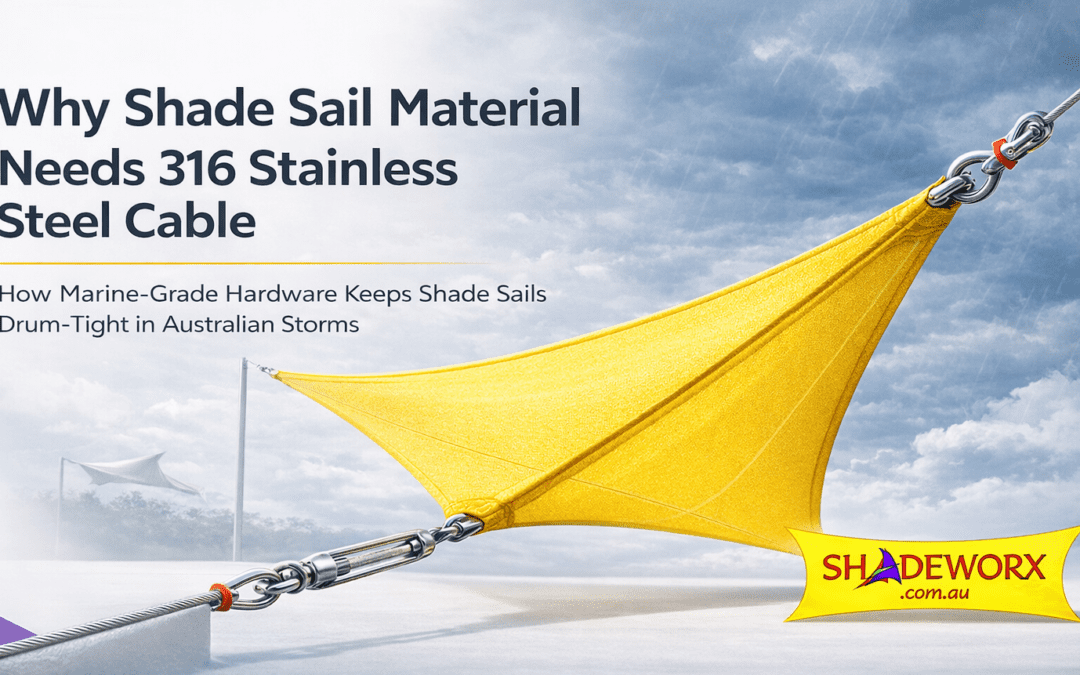
Quick Answer: The best shade sail material combines 316 marine-grade stainless steel cable with quality HDPE shade cloth or waterproof laminated fabric. Shadeworx perimeter-wires every sail with 316 SS cable for drum-tight tensioning that handles Australian storms. Choose HDPE for breathability or waterproof laminate for all-weather protection.
Does shade sail material really matter? Absolutely — and the difference is bigger than most people think.
Picture this. It’s a February arvo in Brisbane. A storm rolls in fast. Your cheap shade sail — the one you picked up online for $80 — starts flapping like a kite. Then it’s gone. Ripped free, taking a wall bracket with it.
Now picture the neighbour’s Shadeworx sail next door. Drum-tight. Not moving. Still perfectly in place when the storm passes.
That’s not luck. That’s shade sail material quality. Let us show you exactly why.
At Shadeworx, we’ve been manufacturing shade sails in Brisbane for over 25 years. We’ve produced more than 24,000 sails for homes and businesses right across Australia — from Brisbane’s northside suburbs to the Gold Coast, Sunshine Coast, Sydney, and Perth. We know exactly what shade sail material works — and what fails when it matters most.
All Shadeworx shade sails are manufactured to Australian quality standards and backed by our product warranty. When you invest in the right shade sail material, you’re investing in something built to last.
The Two Things That Determine Shade Sail Quality
Every shade sail has a skeleton and a skin.
The skeleton is the hardware — the cable, turnbuckles, and fittings that hold everything under tension. The skin is the fabric — the shade cloth material that blocks UV and rain. Get both right and your shade sail material will perform strongly for 10–15 years. Get either one wrong and you’re replacing it within a season or two.
This article covers both in plain English. By the end, you’ll know exactly what to look for — and what to avoid.
Why 316 Stainless Steel Cable Is the Gold Standard
Not all shade sail hardware is built the same. The cable running around the perimeter of your sail carries the entire load. It handles UV exposure, humidity, coastal salt air, and the force of storm gusts — every single day, year after year.
Only one grade of metal does all of that reliably: 316 marine-grade stainless steel.
What Makes 316 SS Different?
316 stainless steel contains molybdenum — a chemical element that gives it superior corrosion resistance compared to standard metals. In Queensland, where humidity is consistently high and coastal conditions are common, this matters enormously. Cheaper metals rust, weaken, and eventually snap under tension.
According to the Australian Radiation Protection and Nuclear Safety Agency (ARPANSA), Queensland regularly records UV index levels of 11+ in summer — the extreme category. That kind of relentless UV exposure destroys inferior shade sail material fast. Your hardware and fabric both need to be built for it.
But corrosion resistance is only part of the story. The real reason 316 stainless steel cable is the right shade sail material choice for hardware is tension.
Why Tension Is Everything
A 316 SS perimeter cable lets you pull the sail drum tight. And a drum-tight sail is everything.
A tight sail deflects wind. It doesn’t catch gusts. It doesn’t flap or billow. When a storm hits, the wind passes over it — similar to how an aircraft wing works. Queensland’s storm season regularly brings gusts exceeding 90km/h. Your shade sail material needs to handle that without budging.
The alternative is webbing straps. They’re cheaper upfront. They’re also a false economy.
Webbing straps stretch over time. They degrade under UV. They can’t be re-tensioned effectively once they’ve relaxed. The result is a saggy, floppy sail that catches wind like a parachute. In a serious storm, that becomes a dangerous projectile — putting enormous stress on walls, posts, and pergola frames.
Every Shadeworx shade sail is perimeter-wired with 316 stainless steel cable as standard. It’s not an optional upgrade. It’s how every single sail leaves our Brisbane factory.
The Turnbuckle Tip Most People Miss
???? Expert Tip: Always lubricate your stainless steel turnbuckles with graphite anti-seize compound or grease before tensioning. Stainless steel can gall — a process where the threads essentially fuse together under pressure without lubrication. A seized turnbuckle means you can’t re-tension your sail when it needs it. It’s a five-second step that saves significant hassle down the track.
Shadeworx supplies a full range of professional shade sail accessories — 316 SS turnbuckles, forged D shackles, roof brackets, diamond pad eyes, and cable trace. All available separately for homeowners and tradespeople upgrading existing setups or replacing worn shade sail hardware.
Choosing the Right Shade Sail Fabric
The shade sail material you choose for the fabric depends on what you need the sail to do. There are two main options — and each suits different situations.
Breathable Shade Cloth — The Residential Go-To
HDPE — High Density Polyethylene — is the standard residential shade sail material across Australia. It’s a knitted fabric, so air flows through it freely.
That breathability matters more than most people realise. The temperature underneath a breathable HDPE sail is noticeably cooler than under a solid structure. On a 35-degree Brisbane summer day, that’s the difference between actually using your backyard and retreating inside.
Quality HDPE shade cloth fabric blocks over 90% of UV rays. With Queensland’s UV index regularly hitting the extreme category, that protection is genuine and measurable. HDPE shade sail material is UV stabilised, lightweight, and built specifically for Australia’s harsh outdoor conditions.
HDPE is the right shade sail material for backyards, pergolas, carports, and garden areas where rain drainage isn’t a primary concern.
Not sure whether a 3-point or 4-point sail suits your space better? We’ve covered that in detail on our shade sail types page.
???? Expert Tip: When fitting a fabric shade sail, always install with seams and hems facing upward. This allows water to run off cleanly rather than pooling at the seam line. Pooled water leads to mould growth, which shortens the life of your shade sail material significantly. It’s a small installation detail that makes a real long-term difference.
Waterproof Shade Sail Fabric — All-Weather Performance
For full rain protection, waterproof shade cloth is the right shade sail material choice. This uses a PVC or PTFE laminated construction that is completely impermeable. Rain runs straight off.
This is commercial-quality shade sail material. Shadeworx waterproof shade sails use laminated fabric with stainless steel cable edges and fully swaged fittings — meaning the cable ends are mechanically compressed rather than simply clamped. That creates a permanent, high-strength connection built to handle long-term tension loads.
Water resistant shade cloth sits between breathable and fully waterproof — it slows water penetration but isn’t completely impermeable. It’s a practical middle-ground option for areas with light seasonal rain.
Waterproof shade sail material is the right call for outdoor entertaining areas, pool surrounds, cafes, school shade structures, and anywhere that needs year-round all-weather coverage.
???? Expert Tip: With waterproof shade sail fabric, the installation rule reverses — laminated side and seams must face downward. This protects the lamination from direct UV breakdown and ensures water runs off correctly. Installing waterproof shade sail material upside down degrades the lamination layer prematurely and significantly shortens the lifespan of the sail.
How Shadeworx Makes It Differently
Choosing the right shade sail material is only half the job. Even the best fabric and cable will underperform if the sail itself is cut incorrectly.
A shade sail needs to be precisely engineered to the attachment points. Get the geometry wrong and the load distributes unevenly across the sail. It distorts under tension, stresses the hardware, and eventually fails — regardless of how good the shade sail material is.
Shadeworx uses tension membrane-specific CAD software to design every sail. The shape isn’t estimated or eyeballed — it’s calculated precisely. Every cut point and angle is engineered for the exact fixing positions on your property.
Our skilled machinists then sew each sail on industrial sewing equipment. The stitching holds under real tension loads — it doesn’t fail at the seams when the sail is pulled drum tight.
This precision is why shade sail material performance and manufacturing quality go hand in hand. One without the other fails. Together, they produce a sail that stays tight, lasts long, and performs when conditions get tough.
One of our Brisbane customers came to us after their second cheap shade sail failed in consecutive storm seasons — both using webbing strap construction. Their Shadeworx replacement — 316 SS cable, precision CAD-cut, drum-tight installation — has now been through three wet seasons without a single issue.
Over 24,000 sails. 25 years. All manufactured in Brisbane. All tested in real Australian conditions.
What Cheap Shade Sail Material Actually Costs You
Here’s the honest economics of shade sail material quality.
A cheap sail built with webbing straps and generic hardware will sag within one or two seasons. The shade sail material weakens under UV exposure. The fittings corrode. The sail loses tension and starts to flap. Then Brisbane’s storm season arrives — and it fails.
Replacing that sail means sourcing new shade sail material, buying replacement hardware, and paying for reinstallation. That combined cost frequently exceeds what a quality Shadeworx sail would have cost from the start.
Buy once. Buy right.
If you already have an existing setup and just want to bring the hardware up to standard, Shadeworx supplies all shade sail accessories separately. Professional-grade 316 SS turnbuckles, D shackles, roof brackets, and diamond pad eyes are all available — so you can upgrade without replacing the entire sail.
Frequently Asked Questions About Shade Sail Materials
What is the best shade sail material for Australian conditions?
HDPE shade cloth is the standard residential shade sail material in Australia. It’s breathable, UV stabilised, and built for the Australian climate. For hardware, 316 marine-grade stainless steel cable is the right choice — it handles coastal humidity, resists corrosion, and allows drum-tight tensioning.
What’s the difference between waterproof and standard shade cloth?
Standard shade cloth is breathable HDPE shade sail material that filters UV but doesn’t block rain. Waterproof shade sail fabric uses a PVC or PTFE laminate that fully blocks water. It’s the right shade sail material for year-round outdoor entertaining areas and commercial applications.
Why do shade sails use stainless steel cable instead of webbing straps?
316 stainless steel cable allows the shade sail material to be stretched drum tight. A tight sail deflects wind rather than catching it. Webbing straps can’t achieve the same tension and degrade much faster under Queensland’s UV and humidity.
How long does shade sail material last?
Quality HDPE shade cloth lasts 10–15 years with proper care and correct installation. Waterproof shade sail material lasts longer when installed with the laminated side down. With 316 stainless steel hardware, your fittings will typically outlast the fabric itself.
Is shade sail material UV rated in Australia?
Yes. Quality HDPE shade cloth used in Australian shade sails is UV stabilised and rated to block 90%+ of UV rays. Look for fabric tested to Australian Standard AS 4174. Shadeworx uses UV-rated shade sail material on every sail manufactured in our Brisbane factory.
Can I upgrade my existing shade sail hardware to 316 stainless steel?
Absolutely. Shadeworx supplies all shade sail accessories separately — 316 SS turnbuckles, D shackles, roof brackets, and diamond pad eyes. Upgrading your hardware is often all it takes to restore proper tension and significantly extend the life of your existing sail.
What’s the difference between 3-point and 4-point shade sail material requirements?
Both use the same high-quality shade sail material — either HDPE or waterproof laminate. The difference is in how tension is distributed. A 3-point sail tensions from three corners. A 4-point sail tensions from four, distributing load more evenly — which is why 4-point sails are popular for larger coverage areas.
The Bottom Line
Cheap shade sail material is a false economy. It sags, it fails, and it ends up costing more in the long run.
The right shade sail material — 316 stainless steel cable hardware combined with precision-cut HDPE or waterproof laminated fabric — is what separates a sail that performs for a decade from one that doesn’t survive a single storm season. Whether you’re in Brisbane, the Gold Coast, Sydney, or anywhere else in Australia, the standard is the same.
Shadeworx has been getting this right for 25 years. Over 24,000 sails manufactured in Brisbane. Every single one built to Australian quality standards and backed by our product warranty.
Ready to get it right the first time? Explore Shadeworx’s full range of residential shade sails and professional-grade hardware at shadeworx.com.au.
About Shadeworx
Shadeworx is Brisbane’s leading shade sail manufacturer with over 25 years of industry experience and more than 24,000 sails produced for residential and commercial customers across Australia. Based in Brisbane, Shadeworx manufactures every sail using tension membrane-specific CAD software and industrial sewing by skilled machinists. All sails are perimeter-wired with 316 stainless steel cable as standard — built to withstand Australia’s toughest conditions. Shadeworx supplies shade sails and professional-grade hardware to homeowners and tradespeople Australia-wide. Visit shadeworx.com.au or email [email protected].
