
A school can have plenty of shade at 9am and very little over the playground at lunchtime, which is why shade sails for schools need more planning than a size and a colour. A childcare centre can have a large shaded area and still leave the sandpit in full sun.
A shade sail also isn’t just fabric. It’s a tensioned structure that pulls hard on its posts and fixings, so it has to be designed, engineered and sometimes approved like one.
This guide is for facilities managers, business managers, P&C committees and childcare centre directors in Brisbane and across Queensland. It covers what to check before you ask for quotes.
Before you buy school shade sails, check these five things:
Where is shade actually needed?
When is each area used?
What shade and sun-safety requirements apply to your school or service?
What fabric and structural design suit the site?
What approvals, engineering and installation will the project need?
Why Do Schools and Childcare Centres Need Shade?
Children spend much of the school day outdoors. The Queensland Department of Education notes that the UV Index is typically at damaging levels (usually above 3) during school hours all year round.
UV exposure during childhood contributes to a person’s cumulative UV exposure over their lifetime, which is relevant to skin cancer prevention. Cancer Council Australia notes that children and teenagers are in school and care settings when UV levels can be high, and recommends a combination of sun-protection measures, including shade.
Shade works alongside hats, clothing, sunscreen and planning outdoor time around peak UV. Well-designed shade can form an important part of a school’s broader UV-protection strategy, and shade sails for schools are one practical way to provide it.
What Are Schools and Childcare Centres Required to Do?
Quick answer:
Requirements depend on the type of school or service and where it operates. Queensland state schools must have a school-based sun safety policy that covers shade provision and use. Applicable centre-based education and care services must provide adequate shaded areas under Regulation 114 of the Education and Care Services National Regulations. Neither rule requires shade sails for schools or childcare centres specifically.
Queensland schools
Queensland state schools must develop, publish and implement a school-based sun safety policy. The Queensland Government lists shade provision and use as one element of that policy, alongside clothing, education, sunscreen, modelling sun-safe behaviour and cost considerations. Department guidelines also ask schools to check whether students can access adequate shade, including permanent and temporary structures.
Independent and Catholic schools may have their own policies. Requirements vary depending on the type of school, service and jurisdiction, so the project’s specific approval and policy requirements should be confirmed before construction.
If your policy says students should use shade at breaks, check that your existing shade is in the right places at those times.
Early learning and childcare services
For applicable centre-based services under the National Quality Framework, ACECQA identifies Regulation 114 (Outdoor space: shade). It requires the approved provider to ensure outdoor spaces include adequate shaded areas to protect children from overexposure to UV radiation. Regulation 168 requires sun-protection policies and procedures, and Regulation 170 requires reasonable steps to make sure they’re followed.
Regulation 114 does not require shade sails. The requirement is for adequate shade, and ACECQA identifies options including trees, heavy shade cloth and solid roofs. Authorised officers consider whether there’s enough shade for the number of children at the service.
Are Shade Sails the Right Choice for Your Site?
Quick answer:
Shade sails suit large, shaped areas that need overhead shade without a full roof. They’re not the only option, and many sites use a mix.
| Option | Potential advantages | Things to consider |
|---|---|---|
| Shade sails | Flexible layouts, large coverage areas, visually lighter structure | Requires careful design, structural support and installation |
| Roofed/COLA structures | Permanent overhead coverage | Can involve different design, approval and cost considerations |
| Trees | Natural shade and environmental benefits | Takes time to establish and shade changes seasonally |
| Umbrellas/portable shade | Flexible positioning | Generally less suitable for large permanent play areas |
Shade sails for schools tend to work well for:
- playgrounds
- outdoor learning areas
- eating areas
- sandpits
- waiting and collection areas
- pool areas
- large open spaces that need engineered coverage
If an area needs rain protection as well as UV protection, waterproof shade sails or a roofed structure may suit better than breathable shade cloth.
How Should Shade Be Positioned Across the School Day?
A large shade sail can look impressive on a plan but still leave part of a playground exposed when the sun moves. Before choosing a size, think about when children use the area and where the sun sits then.
Start with how the space is used
Walk the site with teachers or educators and map:
- active play zones (running, ball games, climbing)
- passive play and quiet areas
- eating areas
- outdoor learning spaces
- sandpits
- seating
- infant and toddler areas
- high-traffic paths and gates
Staff know which spots stay hot. Their input puts shade where it will be used, not where it’s easiest to install.
Think about the sun throughout the day
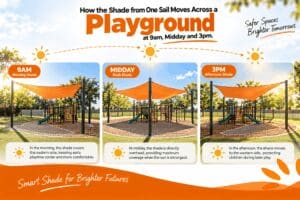
Shade isn’t static. A sail that shades a sandpit at 9am may be shading the fence line by 1pm.
- Morning: the sun is low in the east, so shadows fall long towards the west.
- Midday: the sun is at its highest and UV is usually strongest.
- Afternoon: shadows swing towards the east as the sun moves west.
- Seasons: in Brisbane, the winter sun sits lower in the northern sky, so shadows are longer and fall further south than in summer.
Ask for a sun-path assessment or shade analysis during design, checked against the times the area is used. No sail shape automatically provides all-day shade. Height, angle, orientation and the number of sails all change where shade lands, which is why good school playground shade often uses several overlapping sails at different heights.
[
Why Brisbane site conditions matter
Brisbane’s subtropical climate shapes how shade sails for schools are designed. Summer brings the strongest sun and is also the wettest season, with heavy downpours and storms, so a waterproof sail needs enough fall to shed water quickly. Breathable shade cloth lets rain through but also lets hot air escape on humid days. Wind exposure differs between a sheltered courtyard and an open oval, so the engineer sets wind loads for your actual site. And because most schools want works done outside term time, design and approvals often need to start months before the holidays you’re aiming for.
Consider supervision
School shade structures shouldn’t create avoidable supervision problems. For childcare services, ACECQA identifies Regulation 115, which requires premises to be designed to facilitate supervision. Low sail edges, clusters of posts or hidden corners can make supervision harder. Check sightlines from where staff usually stand, not just from a plan drawing.
What Fabric Should School Shade Sails Use?
Quick answer:
There’s no single best fabric. The right fabric depends on whether the priority is breathable shade, rain protection, durability, aesthetics or a combination of these.
Choose the fabric based on how the area is used
- Playground: breathable shade cloth may be appropriate because it lets hot air escape.
- Eating areas and walkways: waterproofing may be useful so the space works in wet weather.
- Large active areas: airflow and heat management matter more than rain protection.
What to ask your supplier
Two fabrics with similar UV claims can perform very differently in weight, strength, airflow and lifespan.
| Factor | What to ask |
|---|---|
| UV protection | What does the manufacturer’s documentation say about UV performance, and how was it tested? |
| Fabric weight | Is the weight suited to a commercial, high-use setting? |
| Tensile strength | Is the fabric rated for the spans and tension in this design? |
| Breathability | Will hot air escape, or will heat build up underneath? |
| Waterproofing | Do we need rain protection? If so, how will water drain? |
| Colour | How will colour affect the feel of the shade and fading over time? |
| Durability | How is it expected to hold up in Queensland conditions? |
| Warranty | What does the fabric warranty cover, and for how long? |
| Suitability | Is this fabric right for a playground, eating area or pool? |
Shadeworx manufactures both breathable and waterproof sails. Our waterproof sails use commercial-grade waterproof fabrics with a stainless steel cable edge and fully swaged corners. Fabric sails are sewn with seams and hems facing up, so they dry better, build up less mould and keep a clean underside. Waterproof sails have the laminated side, seams and hems facing down to protect the waterproof membrane.
Why Does Perimeter Cabling Matter on School Shade Sails?
Quick answer:
The perimeter cable carries the sail’s tension to its corners. A strong cable edge lets the fabric be pulled tight so it holds its shape instead of sagging and flapping.
Once tensioned, a sail pulls hard on every corner, and wind adds more load. That force travels from the perimeter cable through the corner connections, turnbuckles and shackles, into the posts and footings or an existing building. Each part must be designed for the loads and the ground. Waterproof sails also need enough fall that water runs off instead of pooling.
All Shadeworx shade sails are perimeter-wired with 316 stainless steel cable rather than webbing straps, and our turnbuckles and D shackles are 316 stainless steel too. Proper tensioning and structural design can help the structure perform under expected loads. That’s why commercial shade sails for schools should be engineered for the specific site, wind conditions and ground, rather than chosen off the shelf.
What About Posts, Playground Equipment and Fall Zones?
When planning shade sails for schools and childcare centres, check:
- Post positioning: keep posts out of main running paths and busy play zones where possible.
- Climbing opportunities: position posts, braces and cables so they don’t become extra play equipment.
- Proximity to equipment: keep posts away from slides, swings and climbing frames.
- Fall zones: keep the impact area around play equipment clear of posts and hardware.
- Access routes: keep paths, gates and emergency access clear.
- Trip hazards: keep footings, base plates and bolts out of walkways or finish them flush.
- Hardware position: keep turnbuckles and shackles out of children’s reach where practical.
Clearances depend on the playground equipment, the site and the standards and guidance that apply. Ask your designer and playground safety adviser to confirm them for your equipment.
Do Shade Sails for Schools Need Council or Building Approval?
Quick answer:
It depends on the structure and the site. QBCC guidance identifies circumstances where development approval may be required, including where certain Class 10 structures exceed thresholds such as 10m² plan area, 2.4m height or a 5m side length. The rules can depend on the structure and site, so confirm the approval pathway for your specific project.
The QBCC fact sheet for awnings, sunshades and canopies says development approval may be required where the structure is:
- more than 10m² in plan area
- more than 2.4m in height
- more than 2.1m in mean height (total elevational area facing a boundary divided by its horizontal length facing that boundary)
- longer than 5m on any side.
A large school shade structure can exceed one or more of these thresholds, so approval should be checked early in the design process. For example, a 6m × 6m sail is 36m² in plan area and has 6m sides, so it exceeds two of the dimensions described in the QBCC guidance. For a project of this type, confirm the approval pathway with the relevant building certifier.
QBCC also notes that structural design may require certification by an appropriately qualified professional, and that building products need to be fit for purpose and comply with the relevant regulatory provisions.
Practical steps:
- Ask suppliers early whether they expect approval to be needed.
- Confirm who organises the certifier and engineering, and whether it’s in the quote.
- Build approval time into your timeline, especially if you want installation done in the school holidays.
How Much Do Shade Sails for Schools Cost?
Quick answer:
There’s no reliable average price, because every site is different. The cost of school shade sails depends on the factors below, so an itemised quote based on a site assessment is the most reliable way to budget.
| Cost driver | Why it matters |
|---|---|
| Sail size and number | More fabric, hardware and posts |
| Shape | Long spans and custom shapes need more design |
| Fabric specification | Fabrics vary in price and performance |
| Waterproof vs breathable | Waterproof sails usually need more structure and drainage |
| Number and height of posts | Taller posts carry bigger loads |
| Footings | Size and depth depend on loads and ground |
| Existing structures | Fixing to buildings may need checking or strengthening |
| Site access | Tight spaces or limited machinery access add time |
| Engineering | Site-specific design and certification |
| Installation complexity | Working around an occupied site |
| Approvals and certification | Certifier fees and lead times |
| Ground conditions | Rock, fill or services can change footings |
| Removal of existing structures | Old posts and sails may need removing |
Don’t compare quotes by square metre alone
Two projects with the same sail area can cost very different amounts. A breathable sail on four short posts in open, easy-to-dig ground is a different job from a waterproof sail of the same size on tall posts, with deep footings in rock and one corner fixed to an existing building. Compare what each quote includes, line by line. A cheaper quote that leaves out engineering, footings or approvals can end up costing more.
What Should a Quote for Shade Sails for Schools Include?
A quote should clearly identify:
- sail dimensions
- sail shape
- fabric brand/type
- fabric weight/specification
- UV performance
- waterproof or breathable construction
- perimeter cable
- corner hardware
- posts
- footing design
- structural/engineering requirements
- installation
- removal works, if applicable
- warranties
- maintenance requirements
- expected project timeframe
- exclusions
- approval/certification responsibilities
If any are missing, ask. The answers often explain why two quotes for the same area differ so much.
What Do We Check on a Site Visit?
Before we design shade sails for schools, we look at:
- existing shade at different times of day
- the position of playground equipment
- existing structural attachment points
- proposed post locations
- site access for machinery
- ground conditions
- drainage requirements
- the times of day shade is needed
- wind exposure
- installation constraints during school hours
A post that looks fine on a plan may clash with a fall zone, or a fixing point may not take the load. It’s far cheaper to find that out on site than after fabrication.
Why Choose Custom-Made Shade Sails for Schools?
A custom sail isn’t simply a different shape. Its dimensions, corner heights, attachment points and tensioning are designed around the site. Setting corners at different heights gives the sail a twist, which adds stiffness and helps water run off. Placing the high and low points with the sun path in mind puts shade where children are when they use the space. Sizing the sail to fixing points that can take the load means it can be tensioned properly and stay tight.
That lets the design work around irregular playgrounds, existing buildings, trees, pathways, play equipment, different shade needs across zones, existing structural points, desired coverage and drainage.
Shadeworx brings 25+ years of shade-sail experience to this work, with more than 24,000 shade sails produced and delivered to customers across Australia and beyond. Every sail is made at our Brisbane manufacturing facility using tension-membrane-specific CAD software, and sewn on industrial sewing machinery by skilled machinists. You can see our range of shade sails for schools for more detail.
What Should You Check Before Ordering School Shade Sails?
Before requesting quotes for shade sails for schools:
- ☐ Map the areas requiring shade
- ☐ Identify when each area is used
- ☐ Consider sun movement throughout the day
- ☐ Check existing shade
- ☐ Review your school’s or service’s sun-protection policy
- ☐ Identify playground safety constraints
- ☐ Check approval requirements
- ☐ Determine whether waterproofing is required
- ☐ Establish a realistic budget
- ☐ Ask suppliers about engineering
- ☐ Compare fabric specifications
- ☐ Confirm installation inclusions
- ☐ Compare warranties
- ☐ Ask about maintenance
Frequently asked questions (FAQs)
Planning a New Shade Area?
Send us your site dimensions, photos and the areas you want shaded. Our team can help you work through the design and shade requirements before you request a formal quote. Discuss your school shade project.
