
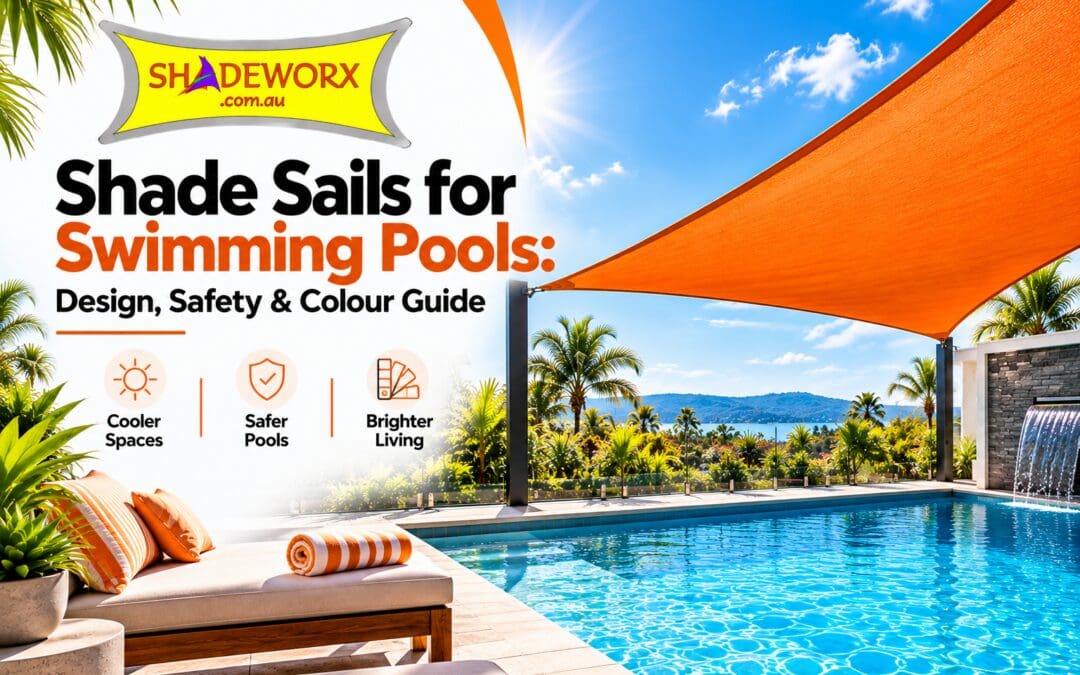
Choosing shade sails for pools isn’t as simple as picking a fabric and hanging it above the water. A pool can be one of the best parts of a Brisbane backyard. But during hot, high-UV stretches, an exposed pool area gets uncomfortable fast.
Getting the shade right means thinking about a few things. Where is shade needed? How much area needs covering? What shape should the sail take? Which fabric and colour suit your pool and your home? And how does it all sit alongside your pool fencing? A well-designed shade sail should work with your pool area, not just sit above it.
Shadeworx is an Australian manufacturer and supplier of custom-made shade sails and hardware, based at a factory in Brisbane. The team has more than 25 years in the industry and has produced over 24,000 shade sails for homes, schools and commercial sites. That experience shapes this guide, which walks through the decisions that matter before you buy.
Why Put a Shade Sail Over a Swimming Pool?
UV protection
A shade sail cuts down direct sun exposure for anyone in or around the pool. How much protection you get depends on the fabric’s weave and colour. Check a fabric’s specifications rather than assume every sail performs the same way.
A cooler, more comfortable pool area
Shade makes poolside seating, entry steps and shallow areas far more pleasant to use in summer. You can expect the air around a shaded pool to feel cooler. Claims about lowering the water temperature by a set amount are harder to back up. That depends on pool size, water turnover and how much surface is covered.
Less debris falling into the pool
A well-positioned sail can help cut down on leaves landing in the water. That means less time with the skimmer net. It’s a genuine perk, but comfort and UV protection are still the bigger reasons to install one.
A more usable outdoor area
Shade extends how long the pool area works for you. Kids play longer without overheating. Guests linger longer. The space becomes an extension of the house, not somewhere you retreat from once the sun gets fierce.
Where Should a Shade Sail Go Over a Pool?
More shade isn’t automatically better shade. Shade the areas people actually use, rather than trying to cover the whole pool:
- The shallow end and pool entry or steps.
- Any children’s play area.
- Poolside seating.
- An adjoining entertaining area, such as a deck.
The shallow end and entry point are usually where homeowners get the most value from shading, since that’s where people linger longest.
It also helps to think about the whole backyard, not just the pool. A custom-designed sail can often shade both the pool and an adjoining entertaining area in one structure, instead of treating them as separate problems.
And consider the sun’s movement. The sun sits differently over your yard at different times of day and across the seasons. A sail that shades the shallow end at 11am might leave it exposed by 3pm. It’s worth mapping this out before you settle on a position.
Which Shade Sail Shape Is Best for a Pool?
There’s no single best shape for every pool. The right configuration depends on your pool’s layout, available fixing points and how much coverage you need.
3-point sails use three fixing points and form a triangle. They suit smaller areas or awkward angles, and can look striking as a design feature on their own.
4-point sails are the most common backyard configuration. Four fixing points allow square or rectangular layouts and custom dimensions across pools, patios and decks.
5- and 6-point designs add more fixing points for irregular layouts, such as L-shaped pools or yards with several structures to work around.
Hyperbolic designs vary the height of each fixing point to create a curved, tensioned shape. This suits homes with a strong architectural style, but it isn’t necessary for every pool.
Your pool’s shape, available fixing points, required coverage and your home’s architecture should determine the shape, not whatever looks cheapest online. Shadeworx’s custom swimming pool shade sails are designed around these variables rather than sold off the shelf.
Fixed Shade Sails vs Retractable Pool Shade
Shade sails aren’t the only option, and each comes with trade-offs.
| Option | Best for | Main advantage | Main limitation |
|---|---|---|---|
| Fixed shade sail | Permanent pool shade | Simple, durable design | Less flexibility |
| Retractable sail | Adjustable shade | Opens and closes as needed | More moving parts, usually pricier |
| Umbrella | Small areas | Easy to reposition | Limited coverage |
| Pergola/roof | Larger outdoor areas | Structure plus shade | More construction to plan |
| Awning | Poolside areas | Flexible coverage | Not suited to every layout |
A fixed sail isn’t automatically the better choice. It’s a different trade-off. If you want permanent, low-maintenance coverage, a fixed sail suits you. If you want to open the area up on overcast days, a retractable system may work better. It comes at the cost of more moving parts and a higher price.
What Fabric Is Best for a Pool Shade Sail?
The right fabric depends on what you want the sail to do.
Standard shadecloth is lightweight and allows airflow. It’s built for UV protection rather than rain protection. This can be a good option when your priority is sun cover and airflow rather than keeping the area dry underneath.
Waterproof shade sail fabric is heavier and laminated, giving both UV protection and rain cover. It’s worth considering if you want to use the poolside area during a downpour. It also needs different drainage design than standard shadecloth, so water has somewhere to go. See our waterproof pool shade sails range.
What about chlorinated environments? There’s no single fabric that’s universally best near chlorinated water without documented testing behind that claim. What matters more is the fabric’s durability, UV resistance, moisture handling and the manufacturer’s own care and warranty conditions. Ask your supplier what their fabric is rated for before you buy. Our shade sail fabric options page sets out the specifications for each fabric Shadeworx offers.
Does Shade Sail Colour Matter?
Colour affects both how your pool area looks and how it feels to use. It’s part of the design, not just a finishing touch.
Light colours suit brighter, modern homes and smaller yards, giving the space an airy feel. Dark colours suit contemporary homes after stronger architectural contrast, and can help define the pool area as its own zone in the yard.
A very dark sail tends to stand out as a feature in its own right. A lighter tone tends to blend into the background, letting the landscaping or architecture take the lead instead.
Avoid simple rules like “dark sails are always hotter” or “light sails always block more UV.” Performance comes down to the specific fabric and its construction, not colour alone.
Before deciding, look at how the sail will sit against:
- Your house exterior and roofline.
- Pool coping and paving.
- Existing landscaping and fencing.
- Outdoor furniture.
- How much visual contrast you actually want.
A charcoal sail can look striking against a light rendered home. A sand or beige tone often blends more naturally into a green, landscaped backyard. Neither is right or wrong. It comes down to the look you want and how much you want the sail to stand out.
| Colour approach | Visual effect |
|---|---|
| Light or neutral | Blends more easily into the surroundings |
| Mid-tone | Balanced visual presence |
| Dark or charcoal | Stronger architectural feature |
| Earthy or sand tones | Works naturally with landscaping |
What Type of Pool Shade Sail Do You Need?
Shopping around for shade sails for pools often means weighing up several options at once. This quick guide can help narrow things down.
| If your priority is… | Consider… |
|---|---|
| UV protection and airflow | Standard shadecloth |
| Sun and rain protection | Waterproof fabric |
| Permanent, low-maintenance coverage | Fixed shade sail |
| Opening the space up on mild days | Retractable system |
| Shading the entry point or shallow end only | A smaller, targeted sail |
| Shading the pool and an entertaining area together | A larger custom design |
| An unusual or irregular pool shape | A custom multi-point sail |
Use this table as a rough guide. Your pool’s layout, fixing points and budget will still shape the final design.
What Makes a Pool Shade Sail Durable?
316 stainless steel perimeter cable. Shadeworx sails are perimeter-wired with marine-grade 316 stainless steel cable. A properly engineered cable edge gives the fabric a strong, even edge for tensioning, and helps the sail hold its intended shape over time.
Heavy-duty yet lightweight fabric. There’s a balance between a fabric strong enough for Brisbane storms and light enough to install without specialist equipment. Ask your supplier what edge construction their fabric uses and how it holds tension over the life of the sail.
Proper tensioning. A shade sail is a tension structure, not a curtain. It isn’t meant to hang loosely. Correct tension keeps the shape, reduces movement in wind, and helps the structure perform as designed.
CAD-designed geometry. Shadeworx sails are manufactured using tension-membrane-specific CAD software and assembled by experienced industrial machinists. When designing a custom pool sail, this process starts with the available fixing points, the areas the homeowner actually wants shaded, and the surrounding structures, before the sail’s geometry is finalised. That matters most when a pool has irregular angles or limited attachment points, since it’s much harder to correct a poor fit after the fact.
These are the details worth asking about before choosing shade sails for pools that need to handle real Brisbane weather, not just a display photo.
How Close Can a Shade Sail Be to a Pool Fence?
This deserves a careful answer, not a simple yes or no.
Queensland’s pool safety standard sets requirements around barrier height, climbable objects, non-climbable zones and gates. The Queensland Building and Construction Commission (QBCC) requires a continuous 900mm non-climbable zone around pool barriers. This zone must stay free of anything that could help a child climb into the pool area. Where a shade sail is fixed to a dividing fence used as a pool barrier, both neighbours share responsibility for keeping that fence compliant, so it’s worth checking with the Queensland Government’s pool safety pages or the QBCC before fixing anything to it.
A shade sail doesn’t automatically make a pool fence non-compliant. But its location, supporting posts and relationship to the barrier all need thought. Fixing points near the fence line can create a climbable object, or interfere with the non-climbable zone, if they aren’t placed carefully.
If there’s any doubt, get the installation checked by a qualified professional. The QBCC recommends engaging a licensed pool safety inspector to confirm compliance for your setup, since every fence line is different.
Should a Pool Shade Sail Be Waterproof?
Not necessarily. It depends on what you want the sail to do.
Choose standard shadecloth when UV protection is the priority, you want airflow, or rain cover isn’t needed. Consider waterproof fabric when rain protection matters, the pool area doubles as an entertaining space, or you want sun and rain cover in one structure.
Waterproof fabrics need different design and installation planning, since water has to be directed somewhere rather than pooling on the sail. See our waterproof pool shade sails range for the options available.
How Big Should a Pool Shade Sail Be?
There’s no universal size. Sizing depends on your pool’s dimensions, where fixing points can go, nearby structures, required clearance and the engineering needed for your span and wind rating.
The advantage of custom manufacturing is that the sail is designed around your actual pool, instead of forcing your pool to fit a standard size.
Can You Install a Pool Shade Sail Yourself?
In some cases, yes. A straightforward fixed sail with clear, accessible fixing points can be a realistic DIY project for a handy homeowner. Shadeworx provides DIY installation guides to support this.
That said, a few things need extra care:
- Structural fixing points and post foundations need to handle real wind loads, not just the weight of the fabric.
- Tension has to be even across all fixing points, which is harder to judge than it looks.
- Anything near a pool fence needs to respect the non-climbable zone.
If your installation involves new posts, structural fixing to the house, or anything near the pool barrier, it’s worth having the plan checked by a professional before you start. A supplier that offers clear installation guidance, like tensioning steps and hardware instructions, makes DIY installation far more manageable.
What Should You Have Ready Before Getting a Quote?
Having a few details ready makes the quoting process faster and more accurate:
- Approximate pool dimensions.
- Photos of the pool area and any existing structures.
- Photos of possible fixing points, such as fences, walls or eaves.
- The areas you most want shaded.
- Whether you need rain protection.
- A preferred colour, if you have one.
- Whether the sail needs to span over a fence or other structure.
Shadeworx also supplies the hardware to match its sails, including heavy-duty turnbuckles, 316 stainless steel D-shackles, roof brackets, stainless steel diamond pad eyes and cable trace systems, designed to work together as one system.
How Much Do Pool Shade Sails Cost?
There’s no reliable single figure, because pricing depends on several variables at once. The biggest cost drivers are usually:
- Sail size and shape.
- Number and location of fixing points.
- Whether new structural posts are needed.
- Fabric type, and standard versus waterproof material.
- Hardware.
- Site access.
- Engineering requirements.
- How custom the design needs to be.
Sail size, fixing points, structural work and fabric choice can all have a significant effect on the final price of shade sails for pools, since they drive both fabric use and structural work. A generic figure rarely fits your yard, so it’s worth getting a quote based on your actual pool dimensions and site conditions.
How to Choose a Pool Shade Sail Manufacturer in Brisbane
A few things are worth checking before choosing a manufacturer for shade sails for pools:
- Experience — has the company manufactured shade sails specifically, not just installed them?
- Manufacturing capability — do they design and fabricate, or resell someone else’s product?
- Appropriate materials — ask about fabric specification, perimeter cable, thread, hardware grade and warranty cover.
- Custom design — pool areas are rarely identical, so custom sizing and geometry matter.
- Installation guidance — a good manufacturer explains tensioning, hardware and care.
- Evidence of completed work — clear technical documentation and project examples help you judge their craft.
Shadeworx has manufactured shade sails from its Brisbane factory for more than 25 years. In that time, it has produced over 24,000 sails for residential, commercial and institutional clients across Australia.
How to Maintain a Shade Sail Over a Pool
A shade sail is a long-term structure, and a little regular attention keeps it performing well:
- Visual inspection every few months.
- Checking tension hasn’t loosened.
- Checking hardware for wear or corrosion.
- Cleaning the fabric to the manufacturer’s instructions.
- Watching for mould, mildew or dirt build-up.
- Inspecting seams and cable condition.
- Checking attachment points after storms.
Hardware maintenance. Shadeworx recommends graphite anti-seize or grease on stainless steel hardware, to help stop components from seizing over time. It’s a simple step that makes future adjustments much easier.
Seam orientation. This small detail makes a real difference. For standard shadecloth, seams should face upward to help reduce mould. For waterproof laminate, seams should face downward, so water sheds properly instead of pooling along the stitching. Getting this the wrong way around at installation can shorten the sail’s life.
Frequently Asked Questions
Planning Shade for Your Pool
A good pool shade sail isn’t simply a piece of fabric placed above the water. It’s a designed tension structure that has to work with your pool’s layout, fixing points, fabric, colour, Brisbane’s weather, and your pool’s safety environment. Getting those details right can make a significant difference to how well the sail performs and how long it remains in good condition.
If you’re planning shade for an existing pool, start with three questions. Which areas do you want shaded? What time of day do they get the most sun? And does rain protection matter to you? From there, a custom design can be built around your pool, fixing points and surrounding structures. Explore Shadeworx’s custom swimming pool shade sails options, or get in touch with the team to talk through a design for your space.
